Bridging generics and biosimilars: new evidence, real-world impact, and regulatory debate to start Volume 15
Published on 2026/04/10
Generics and Biosimilars Initiative Journal (GaBI Journal). 2026;15(1):3.
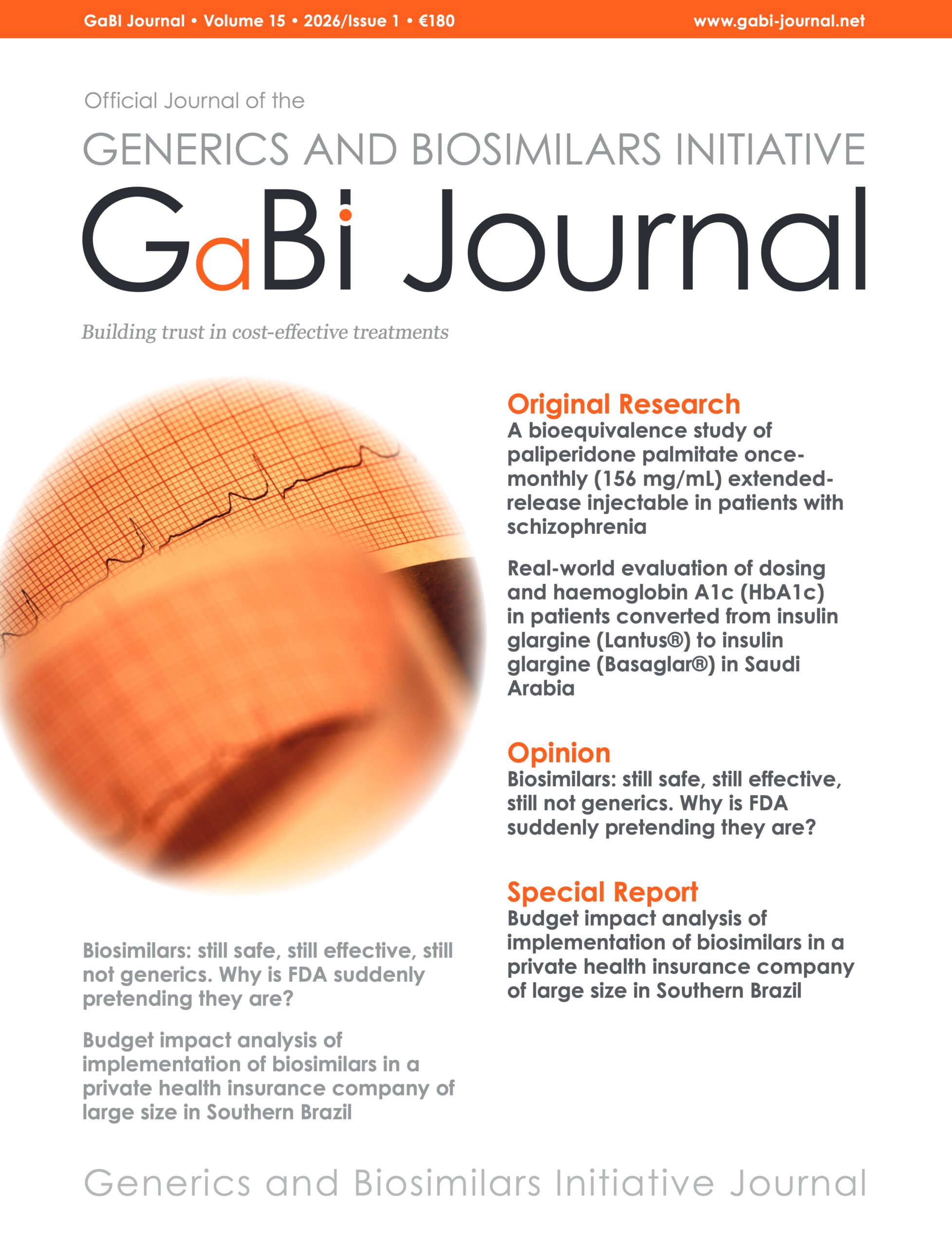
In this first issue of 2026 (Volume 15), we feature two original research manuscripts—one in the generics field and the other on biosimilars—alongside one opinion and one special report, both of which address biosimilar topics.
The first Original Research, titled ‘A bioequivalence study of paliperidone palmitate once-monthly (156 mg/mL) extended-release injectable in patients with schizophrenia’, is authored by Drs Ofer Agid and J Christopher Gorski, Mr Mark Shiyao Liu, and Drs Prasanna C Ganapathi, Mohna Mukund Toro, and Pradeep Purushottamahanti from India. This study aimed to evaluate the steady-state pharmacokinetic bioequivalence of Mylan’s paliperidone palmitate extended-release injectable suspension 156 mg/mL (test formulation) versus Janssen’s Invega Sustenna® (reference formulation) in schizophrenia patients, while also assessing the test formulation’s safety and tolerability. The results demonstrate that Mylan’s PP1M injectable suspension 156 mg is bioequivalent to Janssen’s Invega Sustenna®, indicating that the test formulation is expected to deliver a therapeutic effect equivalent to its branded counterpart. I am particularly pleased to publish a generics paper, as the last two issues of GaBI Journal have lacked reports in this critical area. I strongly encourage potential authors of generics papers to submit their manuscripts to the journal for consideration for publication.
The second Original Research, ‘Real-world evaluation of dosing and haemoglobin A1c (HbA1c) in patients converted from insulin glargine (Lantus®) to insulin glargine (Basaglar®) in Saudi Arabia’, is by Drs Salwa Almomen and Fares Alrubaish, Mr Radwan Hafiz; and Dr Ali M Alhomaidan from the Saudi Food and Drug Authority. This non- interventional, retrospective secondary analysis study utilized electronic medical records from a multi-region healthcare centre, examining patients who switched from Lantus® to Basaglar® between 2020 and 2022. Switching from Lantus® to Basaglar® was implemented according to clinical rec- ommendations without dose concentration change. Although HbA1c levels remained above target overall, the study observed a modest yet statistically significant reduction post-switch. Further investigation is war- ranted to identify factors contributing to persistent suboptimal glycaemic control.
The third manuscript in this issue is an Opinion piece, ‘Biosimilars: still safe, still effective, still not generics. Why is FDA suddenly pretending they are?’, by Mr Michael Reilly, Professor Philip Schneider, and Mr Andrew Spiegel from the Alliance for Safe Biologic Medicines, USA. These authors con- tend that the recent US Health and Human Services (HHS) and the US Food and Drug Administration (FDA) initiative to ‘genericize’ biosimilars—via fast-tracking approvals and eliminating key clinical and switching studies—represents a radical departure from established global regulatory science. They state that this policy dismisses the founda- tional distinction between complex biologi- cals and simple small-molecule drugs. The authors have been consistently critical of FDA biosimilar policy, having published sev- eral prior papers on this topic, some of them in GaBI Journal. I personally find their arguments unconvincing and often question- able, nevertheless, I leave it to our readers to judge the validity of their criticisms.
The final paper in this issue is a Special Report titled ‘Budget impact analysis of implementation of biosimilars in a private health insurance company of large size in Southern Brazil’, by Drs Rafael Baptista Gama and Valderilio, Feijó Azevedo, Ms Paula Heberle, Mr Sergio Mauricio Menoncin, Ms Daniela Toigo, Ms Fabiana Aguiar, Dr Josymar Nascimento Júnior, Ms Ana Carolina Maciel, and Dr Ricardo Luiz Pereira Bueno from Brazil. The report demonstrates that physician-led biosimilar switching significantly reduced biological expenditures while expanding patient access; furthermore, biosimilar competi- tion lowered originator prices, amplifying overall savings. This study was funded by Organon Brazil.
As we open Volume 15, I hope this diverse collection of papers—spanning rigorous bioequivalence trials, real-world glycaemic outcomes, health-economic budget modelling, and polarising regulatory dis- course—showcases the breadth of scholarship that GaBI Journal warmly welcomes. We remain committed to publishing high- quality, peer-reviewed research across the entire spectrum of generic and biosimilar medicines, from preclinical pharmacokinet- ics and clinical interchangeability studies to health-policy analysis and pharmacovigi- lance. I therefore extend an open invitation to researchers, clinicians, regulatory scientists, and health economists worldwide: consider GaBI Journal as the home for your next manuscript. Whether you are presenting novel data, offering a thoughtful critique of current guidelines, or sharing country-specific implementation experiences, your contributions are vital to advancing global access to safe, effective, and affordable medicines. We look forward to receiving your submissions and to fostering continued dialogue in these pages throughout 2026 and beyond.
Robin Thorpe, PhD, FRCPath
Editor-in-Chief, GaBIJournal
Disclosure of Conflict of Interest Statement is available upon request.
Copyright © 2026 Pro Pharma Communications International
Permission granted to reproduce for personal and non-commercial use only. All other reproduction, copy or reprinting of all or part of any ‘Content’ found on this website is strictly prohibited without the prior consent of the publisher. Contact the publisher to obtain permission before redistributing.