Articles


Special Report

Published on 06 May 2024

Physicochemical stability of Azacitidine Accord 25 mg/mL suspension for injection in original vials and polypropylene syringes after reconstitution with refrigerated water for injection

Abstract: The physicochemical stability of Azacitidine Accord, a pyrimidine analogue antineoplastic agent, was assessed after reconstitution with cold water for injection (WFI) and storage in original glass vials and polypropylene (PP) syringes at different temperatures. At 2°C–8°C, stability was observed for 3 days in both containers. At -20°C, stability was maintained for 60 days regardless…

Author(s): Irene Krämer, PhD, Frank Erdnuess, PhD, Judith Thiesen, PhD

azacitidine, physicochemical stability, suspension for injection

DOI: 10.5639/gabij.2024.1302.023


1.368 views

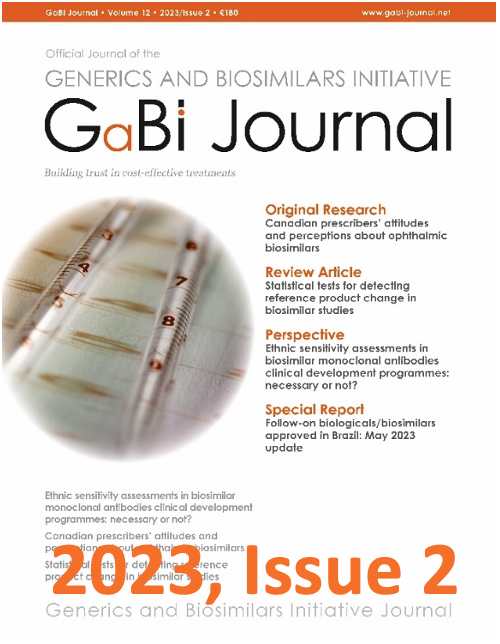
GJ 2023-2 Cover Web V24H08AA Editor's Letter

Published on 14 September 2023

Extrapolation requires reading between the lines

The articles in this second issue of 2023 include an Original Research (Internet questionnaire) of the ‘opinions’ of Canadian ophthalmologists, a Review Article describing a statistical method to assess the ‘drift’ in the attributes of a reference, originator biological product, a Perspective (opinion) article questioning the value of ethnic sensitivity studies (ESS) in the evaluation of…

Author(s): Professor Philip D Walson, MD

DOI: 10.5639/gabij.2023.1202.007


1.350 views

Special Report

Published on 11 September 2024

Physicochemical stability of Doxorubicin Accord 2 mg/mL in punctured original vials and polypropylene syringes and after dilution with 0.9% sodium chloride or 5% glucose solution in polyethylene bottles

Author byline as per print journal: Irene Krämer, PhD; Frank Erdnuess, PhD; Judith Thiesen, PhD Study objectives: To determine the physicochemical stability of Doxorubicin Accord 2 mg/mL concentrate in original glass vials after first opening and after transfer to polypropylene (PP) syringes as well as diluted Doxorubicin Accord solutions (0.05 mg/mL, 1.6 mg/mL) in 0.9%…

concentrated solution, diluted infusion solution, doxorubicin, physicochemical stability

DOI: 10.5639/gabij.2024.1302.011


1.321 views

Special Report

Published on 11 September 2024

Physicochemical stability of Cisplatin Accord in punctured original vials, syringes and after dilution with 0.9% sodium chloride solution

Author byline as per print journal: Irene Krämer, PhD; Frank Erdnuess, PhD; Judith Thiesen, PhD Study objectives: To determine the physicochemical stability of undiluted Cisplatin Accord 1 mg/mL in punctured original vials and polypropylene (PP) syringes as well as after dilution with 0.9% sodium chloride solution in polyethylene (PE) bottles at two different concentrations (0.01…

cisplatin, concentrated solution, diluted infusion solution, HPLC, physicochemical stability

DOI: 10.5639/gabij.2024.1302.021


1.300 views

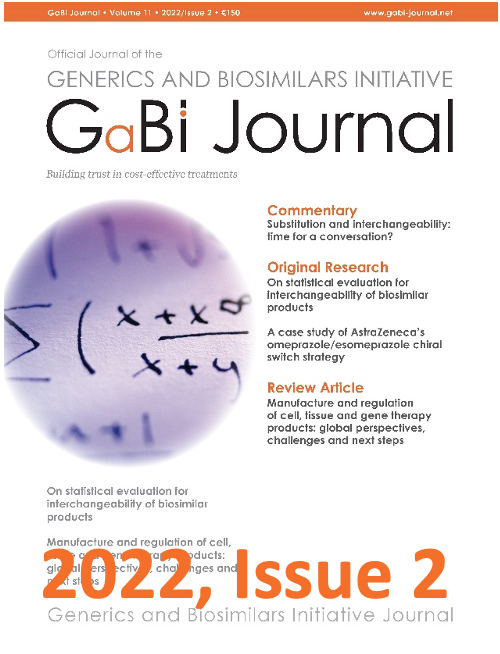
GJ 2022-2 Cover Web V24H08AA Editor's Letter

Published on 08 September 2022

What to look forward to in GaBI Journal, 2022, Issue 2

The rate of successful development, regulatory approval and marketing of both new and follow-on biological treatments has continued to accelerate despite, and in some cases because of, a seemingly endless list of disturbing world events. This GaBI issue contains manuscripts discussing a variety of topics that are already or promise to be critical to maintaining…

Author(s): Professor Philip D Walson, MD

DOI: 10.5639/gabij.2022.1102.008


1.290 views

Special Report

Published on 11 September 2024

Physicochemical stability of Cytarabine Accord in punctured original vials and after dilution with 0.9% sodium chloride solution in polyolefine bags

Author byline as per print journal: Irene Krämer, PhD; Frank Erdnuess, PhD; Judith Thiesen, PhD Study objectives: To determine the physicochemical stability of Cytarabine Accord 100 mg/mL in punctured original vials and after dilution with 0.9% sodium chloride solution in polyolefine (PO) bags stored at room temperature. Methods: Cytarabine Accord 100 mg/mL was diluted with…

concentrated solution, cytarabine, diluted infusion solution, physicochemical stability

DOI: 10.5639/gabij.2024.1302.024


1.276 views

GJ 2023-3 Cover Web V24H08AA Editor's Letter

Published on 10 January 2024

Latest features in GaBI Journal, 2023, Issue 3

The articles in this issue of the GaBI ­Journal highlight two important issues that must be considered when reading scientific publications. The first two articles illustrate the rapidly expanding influence of non-US, non-European economies on the global pharmaceutical industry. The second two articles illustrate the need to carefully evaluate the role of any potential author…

Author(s): Professor Philip D Walson, MD

DOI: 10.5639/gabij.2023.1203.012


1.210 views

Research News

Published on 25 January 2024

Infliximab discontinuation in patients with originator retransition vs biosimilar continuation

Submitted: 4 November 2023; Revised: 24 November 2023; Accepted: 27 November 2023; Published online first: 28 November 2023 A study by Meijboom et al. aimed to compare the risk of and reasons for infliximab discontinuation between retransitioned patients and those remaining on biosimilar [1]. When the market exclusivity of the originator infliximab (Remicade) expired in 2014,…

DOI: 10.5639/gabij.2023.1203.017


1.149 views

Table Contents

Published on 03 January 2023

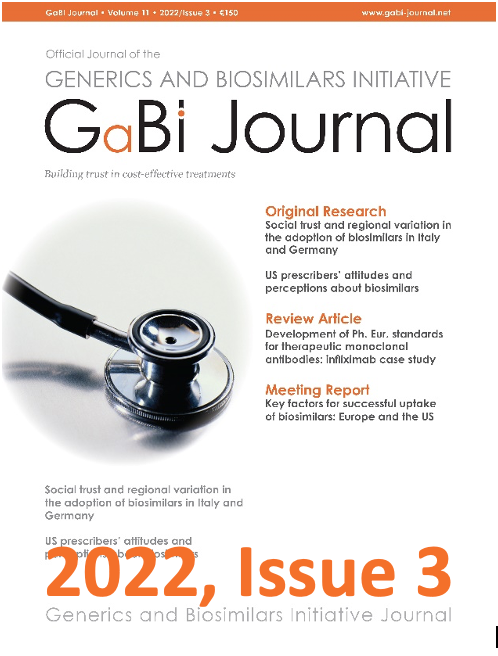
2022/3 GaBI Journal Table of Contents

Contents Editor’s Letter The importance of trust Original Research Social trust and regional variation in the adoption of biosimilars in Italy and Germany US prescribers’ attitudes and perceptions about biosimilars Review Article Development of Ph. Eur. standards for therapeutic monoclonal antibodies: infliximab case study Meeting Report Key factors for successful uptake of biosimilars: Europe and the US


1.140 views

Special Report

Published on 11 September 2024

Physicochemical stability of Methotrexate Accord in punctured original vials and after dilution with 0.9% sodium chloride or 5% glucose solution in non-PVC bags

Author byline as per print journal: Irene Krämer, PhD; Judith Thiesen, PhD Study objectives: To determine the physicochemical stability of Methotrexate Accord 25 mg/mL concentrate in punctured original vials and after dilution with 0.9% sodium chloride or 5% glucose solution in 100 mL non-PVC bags containing 0.1 mg/mL and 20 mg/mL methotrexate stored at different…

concentrated solution, diluted infusion solution, methotrexate, physicochemical stability

DOI: 10.5639/gabij.2024.1302.029


1.140 views