Articles


Review Article

Published on 18 November 2024

A review of international initiatives on pharmaceutical regulatory reliance and recognition

Abstract: In light of recent global health challenges, the need for regulatory reliance – where one regulatory authority accepts the decisions of another – has gained significant interest and momentum. A fundamental role of any government is to protect its citizens and promote a healthy lifestyle by ensuring the quality, safety, and efficacy of medical…

Author(s): Vimal Sachdeva, MSc

authorization, best practice, harmonization, pharmaceuticals, recognition

DOI: 10.5639/gabij.2024.1303.034


2.687 views
Review Article

Published on 30 July 2024

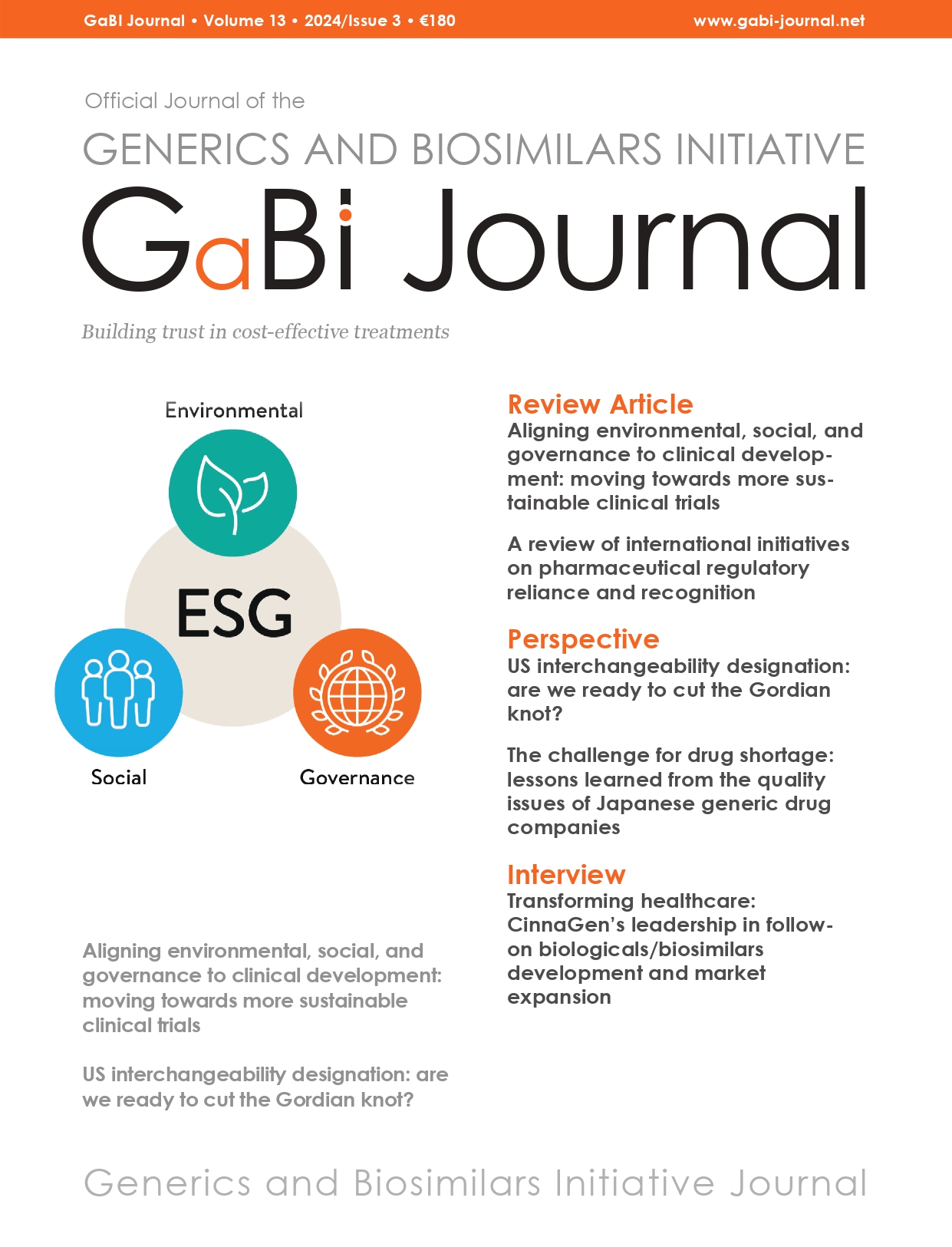
Aligning environmental, social, and governance to clinical development: moving towards more sustainable clinical trials

Abstract:Drug development is among the highest producers of greenhouse gas (GHG) emissions, with about 4.4%–4.6% of the worldwide GHG emissions coming from the thousands of clinical trials being carried out annually by the pharmaceutical industry. In a world where environmental stewardship, social diversity, and equitable governance (ESG) are progressively becoming biomarkers of business purpose, adopting…

Author(s): Shivani Mittra, MPharm, PhD, Shylashree Baraskar, MBBS, Elena Wolff-Holz, MD, Sandeep N Athalye, MBBS, MD

biological, biosimilars, carbon footprint, clinical trials, ESG (Environmental Social Governance), sustainability

DOI: 10.5639/gabij.2024.1303.033


2.370 views

Editor's Letter

Published on 15 December 2024

Third and final issue of GaBI Journal’s 13th volume

This third issue of GaBI Journal is the last of the volume for this year and marks the end of the first year of me taking up the Editor-in-Chief position for the journal. We have seen a very considerable variety of papers submitted and published during 2024. The first Review Article in this issue by…

Author(s): Robin Thorpe, PhD, FRCPath

DOI: 10.5639/gabij.2024.1303.032


565 views

Special Report

Published on 11 September 2024

Physicochemical stability of Fludarabine Accord in punctured original vials and after dilution with 0.9% sodium chloride solution

Author byline as per print journal: Irene Krämer, PhD; Frank Erdnuess, PhD; Judith Thiesen, PhD Study objectives: To assess the physicochemical stability of fludarabine in punctured original vials and after dilution with 0.9% sodium chloride solution at three different concentrations (0.25 mg/mL, 1.2 mg/mL, 6.0 mg/mL) in commonly used infusion containers. Methods: Test solutions were…

concentrated solution, diluted infusion solution, fludarabine, HPLC, physicochemical stability

DOI: 10.5639/gabij.2024.1302.031


1.222 views

Special Report

Published on 11 September 2024

Physicochemical stability of Pemetrexed Accord 25 mg/mL in punctured original vials and after dilution with 0.9% sodium chloride solution in non-PVC bottles

Author byline as per print journal: Irene Krämer, PhD; Frank Erdnuess, PhD; Judith Thiesen, PhD Abstract: In this study, the physicochemical stability of Pemetrexed Accord 25 mg/mL concentrate and its diluted infusion solutions was examined under various storage conditions. Pemetrexed Accord 25 mg/mL remained physicochemically stable for 28 days when stored protected from light in…

concentrated solution, diluted infusion solution, HPLC, pemetrexed, physicochemical stability

DOI: 10.5639/gabij.2024.1302.030


904 views

Special Report

Published on 11 September 2024

Physicochemical stability of Methotrexate Accord in punctured original vials and after dilution with 0.9% sodium chloride or 5% glucose solution in non-PVC bags

Author byline as per print journal: Irene Krämer, PhD; Judith Thiesen, PhD Study objectives: To determine the physicochemical stability of Methotrexate Accord 25 mg/mL concentrate in punctured original vials and after dilution with 0.9% sodium chloride or 5% glucose solution in 100 mL non-PVC bags containing 0.1 mg/mL and 20 mg/mL methotrexate stored at different…

concentrated solution, diluted infusion solution, methotrexate, physicochemical stability

DOI: 10.5639/gabij.2024.1302.029


1.676 views

Special Report

Published on 11 September 2024

Physicochemical stability of Docetaxel Accord 20 mg/mL concentrate diluted with 0.9% sodium chloride or 5% glucose solution in non-PVC bags

Author byline as per print journal: Irene Krämer, PhD; Frank Erdnuess, PhD; Judith Thiesen, PhD Study objectives: To determine the physicochemical stability of Docetaxel Accord infusion solutions 0.3 mg/mL and 0.9 mg/mL in non-PVC-bags either pre-filled with 0.9% sodium chloride solution or 5% glucose solution for up to 98 days. Methods: Docetaxel Accord 20 mg/mL…

diluted infusion solution, docetaxel, HPLC, physicochemical stability

DOI: 10.5639/gabij.2024.1302.028


1.407 views

Special Report

Published on 11 September 2024

Physicochemical stability of Cabazitaxel Accord in punctured original vials and after dilution with 0.9% sodium chloride or 5% glucose solution in non-PVC bottles

Author byline as per print journal: Irene Krämer, PhD; Frank Erdnuess, PhD; Judith Thiesen, PhD Study objectives: To determine the physicochemical stability of undiluted Cabazitaxel Accord in punctured original vials and after dilution with 0.9% sodium chloride solution or 5% glucose solution in non-PVC bottles at the concentrations 0.1 mg/mL and 0.26 mg/mL. Methods: Punctured…

cabazitaxel, concentrated solution, diluted infusion solution, HPLC, physicochemical stability

DOI: 10.5639/gabij.2024.1302.027


1.006 views

Special Report

Published on 11 September 2024

Physicochemical stability of Gemcitabine Accord 100 mg/mL in punctured original vials and after dilution with 0.9% sodium chloride in polyolefine bags

Author byline as per print journal: Irene Krämer, PhD; Frank Erdnuess, PhD; Judith Thiesen, PhD Study objectives: To determine the physicochemical stability of Gemcitabine Accord 100 mg/mL concentrate in original vials after first opening and after dilution with 0.9% sodium chloride solution in polyolefine (PO) bags at concentrations of 0.1 mg/mL and 10 mg/mL. Methods:…

concentrated solution, diluted infusion solution, gemcitabine, physicochemical stability

DOI: 10.5639/gabij.2024.1302.026


1.345 views

Special Report

Published on 11 September 2024

Physicochemical stability of Fluorouracil Accord in three different concentrations in portable elastomeric infusion pumps

Author byline as per print journal: Irene Krämer, PhD; Frank Erdnuess, PhD; Judith Thiesen, PhD Study objectives: To determine the physicochemical stability of Fluorouracil Accord 50 mg/mL solution for injection or infusion in three different types of elastomeric infusion pumps over 42 days, either undiluted (50 mg/mL) or after dilution with 0.9% sodium chloride or…

concentrated solution, diluted infusion solution, elastomeric infusion pump, fluorouracil, physicochemical stability

DOI: 10.5639/gabij.2024.1302.025


2.838 views

Special Report

Published on 11 September 2024

Physicochemical stability of Cytarabine Accord in punctured original vials and after dilution with 0.9% sodium chloride solution in polyolefine bags

Author byline as per print journal: Irene Krämer, PhD; Frank Erdnuess, PhD; Judith Thiesen, PhD Study objectives: To determine the physicochemical stability of Cytarabine Accord 100 mg/mL in punctured original vials and after dilution with 0.9% sodium chloride solution in polyolefine (PO) bags stored at room temperature. Methods: Cytarabine Accord 100 mg/mL was diluted with…

concentrated solution, cytarabine, diluted infusion solution, physicochemical stability

DOI: 10.5639/gabij.2024.1302.024


1.740 views

Special Report

Published on 06 May 2024

Physicochemical stability of Azacitidine Accord 25 mg/mL suspension for injection in original vials and polypropylene syringes after reconstitution with refrigerated water for injection

Abstract: The physicochemical stability of Azacitidine Accord, a pyrimidine analogue antineoplastic agent, was assessed after reconstitution with cold water for injection (WFI) and storage in original glass vials and polypropylene (PP) syringes at different temperatures. At 2°C–8°C, stability was observed for 3 days in both containers. At -20°C, stability was maintained for 60 days regardless…

Author(s): Irene Krämer, PhD, Frank Erdnuess, PhD, Judith Thiesen, PhD

azacitidine, physicochemical stability, suspension for injection

DOI: 10.5639/gabij.2024.1302.023


1.789 views