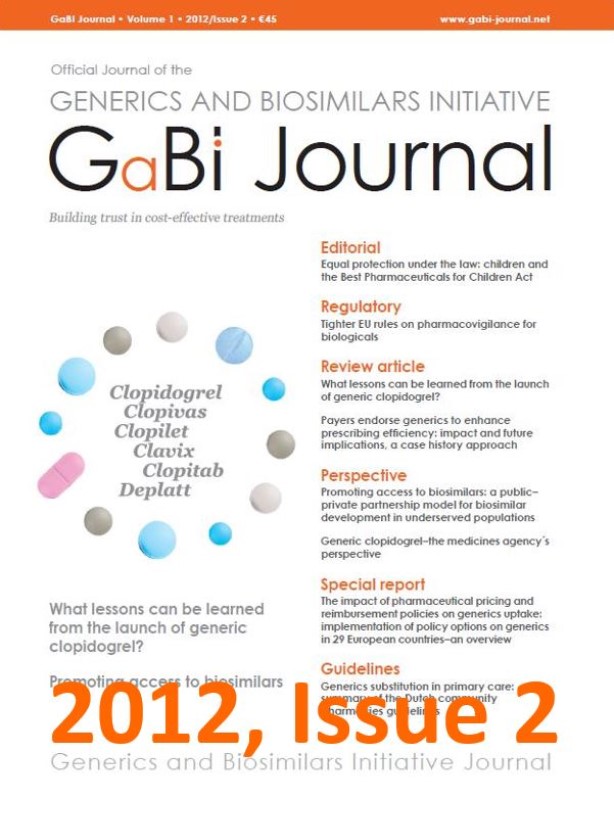
Articles


Editorial

Published on 02 May 2012

Equal protection under the law: Children and the Best Pharmaceuticals for Children Act

Abstract:  Four changes to the Best Pharmaceuticals for Children Act and the Pediatric Research Equity Act will markedly improve these programmes: expanded attention paid to neonatal studies, support for the off -patent programme, timing and submission of paediatric plans, and the per­manence of the legislation. Submitted: 30 November 2011; Revised manuscript received: 2 March 2012;…

Author(s): Professor Daniel Kelly Benjamin Jr, MD, MPH, PhD, Professor Gregory L Kearns, PharmD, PhD

Best Pharmaceuticals for Children Act, clinical studies, legislation, neonates, off-patent drugs

DOI: 10.5639/gabij.2012.0102.014


37.464 views

Editor's Letter

Published on 29 June 2012

What to look forward to in GaBI Journal, 2012, issue 2

It is my pleasure to introduce the second edition of GaBI Journalwhich contains a number of interesting articles. Professors Benjamin and Kearns present a review of advances in paediatric drug development and labelling, see pages 54–55. This follows on my prior comments about how generics and biosimilars may fail to meet the needs of children [1].…

Author(s): Professor Philip D Walson, MD

DOI: 10.5639/gabij.2012.0102.013


5.578 views

Rhythm

Published on 15 February 2012

Clinical biosimilar data should be accessible to all Calls are growing for biosimilar manufacturers to publish their data in the public domain, particularly when developing versions of monoclonal antibodies that are associated with potential survival benefits. One of GaBI Online’s readers totally agrees with this message. However, few others wonder why biosimilar producers must handle safety and efficacy data with…

Author(s): GaBI Journal Editor

DOI: 10.5639/gabij.2012.0101.012


9.132 views

Special Report

Published on 14 February 2012

How matrix models can support generic medicine prescribing

Abstract:  This paper describes the design of currently available matrix models and assesses the experience with these models to date. Matrix models provide a valuable tool to facilitate transparent and interactive evidence-based medicine prescribing. In many cases, generically available drugs perform well because of the documented effects on clinically relevant endpoints, good clinical efficacy, extensive…

Author(s): Robert Janknegt, PharmD, PhD

InforMatrix, matrix models, System of Objectified Judgement Analysis (SOJA)

DOI: 10.5639/gabij.2012.0101.011


15.192 views

Perspective

Published on 13 February 2012

Generic and therapeutic orphans

Abstract:  This commentary discusses the need to develop methods to ensure the availability of non-profitable, off-patent medicines to children and other populations. The history and some of the shortcomings of legislative attempts to provide drug therapy to children are briefly reviewed. Some examples of the inability of the current generics and non-generics pharmaceutical industry as…

Author(s): Professor Philip D Walson, MD

off-patent drugs, orphan, paediatric

DOI: 10.5639/gabij.2012.0101.010


11.650 views

Perspective

Published on 13 February 2012

Myths, questions, facts about generic drugs in the EU

Abstract: Many generic drugs are now being prescribed and the trend is increasing. For example, in Austria, the number of all generics prescriptions has more than doubled from 11% in 2000 to 23% in 2010. However, many myths and questions about generic drugs remain and information may be difficult to come by. It is therefore…

Author(s): Christoph Baumgärtel, MD, MSc

bioequivalence, drug substitution, generics authorisation, legislation, patent, therapeutic equivalency/outcome

DOI: 10.5639/gabij.2012.0101.009


83.638 views

Review Article

Published on 21 February 2012

A review of patient perspectives on generics substitution: what are the challenges for optimal drug use

Author byline as per print journal: Helle Håkonsen, MScPharm, PhD; Else-Lydia Toverud, MScPharm, PhD Introduction: With a few exceptions, generic drug use has been promoted in western countries by allowing pharmacists to substitute drugs defined as therapeutically equivalent generics. The aim of this literature review is to summarise the research on the patients’ perspectives of generics substitution…

Author(s): Else-Lydia Toverud, MScPharm, PhD, Helle Håkonsen, MScPharm, PhD

cost containment, generic drugs, generics prescribing, generics substitution, patient perspectives

DOI: 10.5639/gabij.2012.0101.008


40.348 views

Review Article

Published on 21 February 2012

European payer initiatives to reduce prescribing costs through use of generics

Author byline as per print journal:  Brian Godman1,2,3, BSc, PhD; Bjorn Wettermark1,4, MSc, PhD; Iain Bishop5, BSc; Thomas Burkhardt6, MSc; Jurij Fürst7, PhD; Kristina Garuoliene8, MD; Ott Laius9, MScPharm; Jaana E Martikainen10, Lic Sc(Pharm); Catherine Sermet11, MD; Inês Teixeira12, BA, MSc; Corrine Zara13, PharmD; Lars L Gustafsson1, MD, PhD Introduction: Pharmaceutical expenditure is increasingly scrutinised by payers of health…

Author(s): Brian Godman, BSc, PhD, et al.

demand measures, generics, pharmaceuticals, pricing

DOI: 10.5639/gabij.2012.0101.007


57.246 views

Review Article

Published on 21 February 2012

A patient-centred paradigm for the biosimilars market

Abstract: The advent of similar biological medicinal products or ‘biosimilars’ in Europe in the 2000s has led to development of a global biosimilars market and regulatory frameworks designed specifically for approval of biosimilars. Like originator biologicals, biosimilars exhibit greater molecular complexity than small-molecule drugs, including generics. Current estimates suggest that biosimilars are more expensive and…

Author(s): James N Class, PhD, Lauren Langis, JD

biosimilars, medical devices, outcomes, patients, prescribers, public policy

DOI: 10.5639/gabij.2012.0101.006


41.648 views

Review Article

Published on 21 February 2012

Biologicals and biosimilars: a review of the science and its implications

Abstract: Biopharmaceuticals are medicines whose active drug substance is made by living cells. Copies of these drugs, called biosimilars, are not identical to their reference drug and therefore specific regulatory requirements for registration apply. Whereas pharmaceutical quality evaluation requires a full dossier and a detailed comparative analysis to the reference drug, non-clinical and clinical requirements…

Author(s): Professor Paul J Declerck, PhD

biological, biopharmaceutical, biosimilar, interchangeability

DOI: 10.5639/gabij.2012.0101.005


76.280 views

Review Article

Published on 21 February 2012

A review of generic medicine pricing in Europe

Introduction: Switching from originator products to generic equivalents is a key method used by governments to reduce costs and keep their healthcare systems sustainable. The aim of this article is to review generic medicine pricing in Europe by analysing the factors that influence them. Methods: The literature review focused on selected studies that highlighted generic…

Author(s): Steven Simoens, MSc, PhD

Europe, generic medicines, pharmaceutical policy, pricing

DOI: 10.5639/gabij.2012.0101.004


233.290 views

Commentary

Published on 14 February 2012

Innovator companies should focus on innovations

Abstract: Despite biopharmaceuticals having an enormous potential value for our health, they have also become a serious threat to our healthcare systems. Submitted: 22 June 2011; Revised manuscript received: 6 October 2011; Accepted: 11 October 2011 Recombinant drugs, or biologicals as they are widely termed, are highly complex drug substances that have added tremendous treatment…

Author(s): Professor Theodor Dingermann, PhD

DOI: 10.5639/gabij.2012.0101.003


8.857 views