Articles


Special Report

Published on 21 September 2016

US FDA proposals for naming of biologicals and labelling of biosimilars

Abstract: There is considerable concern and debate over the naming of biologicals and labelling of biosimilars. To ensure that patients receive the safest and most effective treatment, it is paramount that clinicians, prescribers and patients themselves have the relevant information regarding drug treatment. In response to concerns over how biologicals and biosimilars should be named…

Author(s): GaBI Journal Editor

biologicals, biosimilars, labelling, naming, nomenclature, regulation

DOI: 10.5639/gabij.2016.0503.036


9.710 views

Meeting Report

Published on 03 October 2016

Demonstrating interchangeability and biosimilarity for US biosimilars

Abstract: The US Food and Drug Administration (FDA) outlines its approach to biosimilarity and interchangeability at the 2016 Generic Pharmaceutical Association Biosimilars Council Conference. Topics covered include the FDA definition of biosimilarity, its step-wise approach to the approval process and factors/issues that should be considered when providing scientific justification for extrapolation. Submitted: 22 September 2016;…

Author(s): GaBI Journal Editor

biologicals, biosimilar, biosimilarity, interchangeability, regulation

DOI: 10.5639/gabij.2016.0503.035


4.627 views

Meeting Report

Published on 21 September 2016

First Turkish interactive workshop on regulation and approval of similar biotherapeutic products/biosimilars, 2–3 March 2016, Ankara, Turkey

Abstract: This paper discusses the findings and summary of items covered in the First Turkish interactive workshop on regulation and approval of similar biotherapeutic products/biosimilars, in which structure–function was highlighted as a key issue. Submitted: 4 June 2016; Revised: 7 September 2016; Accepted: 15 September 2016; Published online first: 28 September 2016 Introduction This interactive…

Author(s): Professor Philip D Walson, MD, Robin Thorpe, PhD, FRCPath

glycosylation, immunogenicity, potency, receptor binding, serum half-life, sialic acid

DOI: 10.5639/gabij.2016.0503.034


8.584 views

Perspective

Published on 24 October 2016

Biosimilars in Italy: a gastroenterologist’s view

Author byline as per print journal: Vito Annese, MD; Tommaso Gabbani, MD; Antonio Luca Annese, MD Abstract: The introduction of biological therapy has revolutionized the paradigm of treatment in the last two decades. This is expected to lead to corresponding amelioration of the course of several immune-mediated diseases, including inflammatory bowel diseases (IBD). However, this…

Author(s): Antonio Luca Annese, MD, Tommaso Gabbani, MD, Vito Annese, MD

adalimumab, biosimilar, Crohn’s disease (CD), inflammatory bowel disease (IBD), switching, ulcerative colitis (UC)

DOI: 10.5639/gabij.2016.0503.033


7.647 views

Perspective

Published on 03 October 2016

Are the perspectives regarding the use of biosimilars in the setting of haematology and blood and marrow transplant changing?

Introduction: Canada is among the leading spenders in pharmaceuticals. Based on projected figures, the cost of pharmaceuticals is expected to rise by another 6–12% by 2023. Approximately CAN$4.6 billion of healthcare funding is spent on biological drugs (including growth factors and monoclonal antibodies) which are commonly used in the setting of haematology and blood and…

Author(s): Cherie C Severson, RN, MN, CON(C), BMTCN

biologicals, biosimilars, blood and marrow transplant, cost, haematology, subsequent entry biologics (SEBs)

DOI: 10.5639/gabij.2016.0503.032


6.485 views

Perspective

Published on 03 October 2016

Regional management of biosimilars in Germany

Abstract: Biosimilars of tumour necrosis factor-alpha (TNF-α) inhibitors, such as infliximab or etanercept, have recently entered the market. The management of these new products by the healthcare systems differ between European countries, and there may be regional differences within countries. This paper describes prescription structures and approaches to manage the uptake of biosimilars in Germany.…

Author(s): Mathias Flume, MBA, PhD

biosimilar, etanercept, Germany, infliximab, regional management, TNF-α inhibitor

DOI: 10.5639/gabij.2016.0503.031


7.709 views

Perspective

Published on 06 July 2016

Pharmacovigilance on biologicals and biosimilars: a Danish perspective

Abstract: The development of biological medicinal products is in rapid growth and as patents for reference products expire, new biosimilar products become available. This has a marked impact on several stakeholders; from patients and physicians to decision-makers, and on activities; from treatment of patients to the conduct of pharmacovigilance. The Danish Medicines Agency (Laegemiddelstyrelsen, DKMA)…

Author(s): Benedicte Lunddahl, DVM

biological medicinal products, biosimilars, national competent authority, pharmacovigilance

DOI: 10.5639/gabij.2016.0503.030


10.939 views

Review Article

Published on 04 July 2016

The generic medicines system in Italy: scenarios for sustainable growth

Author byline as per print journal: Federico Fontolan1, MA; Silvia Zucconi1, MStat; Carlo Piccinni2, PhD Abstract: In this paper, an overview is provided of the present Italian generic medicines system. Data on generic medicines market share and enterprise performance were reviewed and discussed, and the results of a survey completed by general practitioners (Computer Assisted…

Author(s): Carlo Piccinni, PhD, Federico Fontolan, MA, Silvia Zucconi, MStat

economic sustainability, generic medicines, manufacturing provision, pharmacoeconomics

DOI: 10.5639/gabij.2016.0503.029


14.717 views

Review Article

Published on 22 August 2016

Current state of subsequent entry biologics (biosimilars) in Canada: a view from regulatory, reimbursement, clinician, and patient perspectives

Abstract: Biological molecules represent a significant portion of therapies utilized in Canada. Biosimilars, also known as subsequent entry biologics (SEBs) in Canada, are highly comparable versions of the originator products. Over the next few years, a number of patents for innovator biologicals will expire in Canada and this creates a tremendous opportunity for the entrance…

Author(s): Eric CK Siu, MSc, PhD, George Wyatt, BSc, MBA

biosimilars, CADTH, Canada, CDR, pCODR, subsequent entry biologics (SEBs)

DOI: 10.5639/gabij.2016.0503.028


18.812 views

Commentary

Published on 29 June 2016

Biosimilars: achieving long-term savings and competitive markets

Author byline as per print journal: Jorge Mestre-Ferrandiz, PhD; Adrian Towse, MA; Mikel Berdud, PhD Abstract: Payers need to think strategically in medium/long term to maximize benefits from biosimilars. Concerns about biosimilars’ interchangeability/substitution (with their reference product) and uncertainty about outcomes act as barriers for their uptake. This paper recommends a policy which provides: (1)…

Author(s): Adrian Towse, MA, Jorge Mestre-Ferrandiz, PhD, Mikel Berdud, PhD

biosimilars, competition, incentives, real world data, savings, value for money

DOI: 10.5639/gabij.2016.0503.027


7.202 views

Letters to the Editor

Published on 26 October 2016

Is the EU ready for non-biological complex drug products?

Author byline as per print journal: Jon SB de Vlieger, PhD; Professor Gerrit Borchard, PharmD, PhD; Vinod P Shah, PhD; Beat Flühmann, PhD; Sesha Neervannan, PhD; Professor Stefan Mühlebach, PhD Abstract: Comment on the Regulatory paper by Dr Falk Ehmann and Dr Ruben Pita: The EU is ready for non-biological complex medicinal products, published in…

Author(s): Beat Flühmann, PhD, Jon SB de Vlieger, PhD, Professor Gerrit Borchard, PharmD, PhD, Professor Stefan Mühlebach, PhD, Sesha Neervannan, PhD, Vinod P Shah, PhD

complex drug products, EMA, generics, harmonization, non-biological complex drug (NBCD), therapeutic equivalence, US Food and Drug Administration (FDA)

DOI: 10.5639/gabij.2016.0503.026


7.284 views
Editor's Letter

Published on 26 October 2016

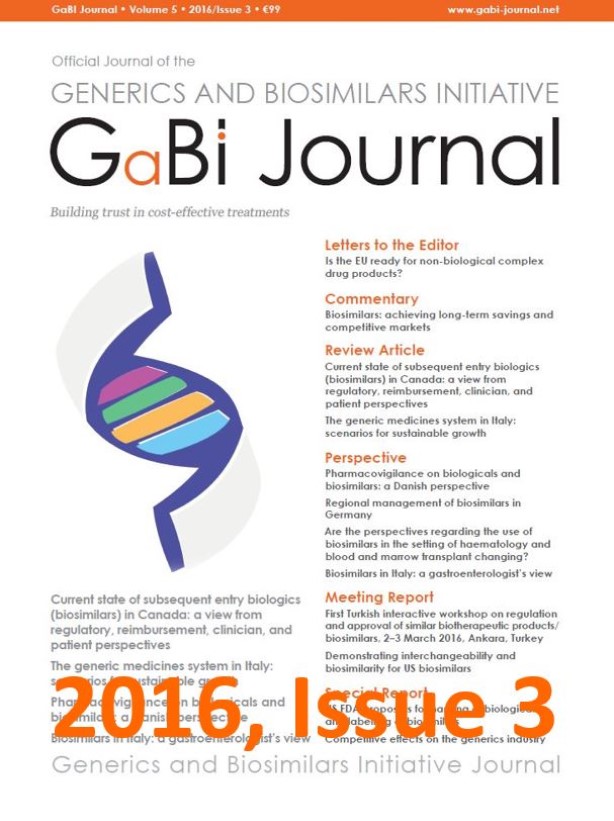
Latest features in GaBI Journal, 2016, Issue 3

The informed, appropriate use of follow-on pharmacological agents can provide significant cost savings for patients and payers. These savings can then be used by governments and patients to increase access to health care. However, the actual savings realized depend on a complex series of factors including how ‘similar’ the products actually are to the innovator…

Author(s): Professor Philip D Walson, MD

DOI: 10.5639/gabij.2016.0503.025


3.231 views