Articles


Perspective

Published on 11 October 2012

Why bioequivalence and unconditional interchangeability of generic drugs are not the same

Abstract: The patents for a number of cornerstone immunosuppressive drugs used in the field of solid organ transplantation have expired. Generic formulations are now available and several professional societies and individual physicians have given their opinions on the issue of generics substitution. In this issue of GaBI Journal, several hot topics related to implementation of…

Author(s): Professor Teun van Gelder, MD, PhD

bioequivalence, generics substitution, immunosuppression, transplantation

DOI: 10.5639/gabij.2013.0202.020


22.566 views

Review Article

Published on 30 April 2013

Pharmacokinetics of antimicrobials in obese children

Author byline as per print journal: Mario R Sampson, PharmD; Michael Cohen-Wolkowiez, MD, PhD; Professor Daniel Kelly Benjamin Jr, MD, MPH, PhD; Edmund V Capparelli, PharmD; Kevin M Watt, MD Introduction: Childhood obesity is common and results in substantial morbidity. The most commonly prescribed drugs in obese children are antibiotics. However, physiological changes associated with…

Author(s): et al., Mario R Sampson, PharmD

antimicrobial agents, obesity, paediatric, pharmacokinetics

DOI: 10.5639/gabij.2013.0202.025


23.624 views

Original Research

Published on 06 March 2013

How do regional sickness funds encourage more rational use of medicines, including the increase of generic uptake? A case study from Austria

Objective: To analyse similarities and differences between activities carried out by Austrian sickness funds to encourage more rational use of medicines, including increasing generics uptake. Methods: Semi-structured interviews with pharmacoeconomic unit staff of four regional sickness funds in Austria. Results: Sickness funds include a variety of activities. The main target group is prescribers, who are…

Author(s): Sabine Vogler, PhD, Nina Zimmermann, MA

generics, generics uptake, medicines, monitoring, prescribing, rational use of medicines, sickness funds

DOI: 10.5639/gabij.2013.0202.027


42.558 views

Letters to the Editor

Published on 18 April 2013

Challenges to generic medicines utilization in Yemeni healthcare system

Abstract: Generic medicines are promoted in many countries as an essential part of the healthcare system. However, in Yemen, there are many challenges to the utilisation of generic medicines. Currently, there is no national level policy to enhance or promote generic medicines use. In addition, other challenges to the use of generic medicines in Yemen…

Author(s): Saleh Karamah AL-Tamimi, BPharm, MPharm (ClinPharm), Mohamed Azmi Ahmad Hassali, PhD, Alian A Alrasheedy, BPharm(Hons), MPharm(Clin), BCPS

challenges, consumers, generic medicines, healthcare professionals, Yemen

DOI: 10.5639/gabij.2013.0202.017


13.846 views

Letters to the Editor

Published on 30 April 2013

Access to liposomal generic formulations: beyond AmBisome and Doxil/Caelyx

Abstract: The lack of clear regulatory guidance remains a key bottleneck for securing a second quality-assured source of liposomal amphotericin B (LAmB), the WHO-recommended drug for visceral leishmaniasis. The approval of the first generic liposomal product by the US Food and Drug Administration in February 2013 could be a turning point, and serve as a…

Author(s): Barbara Milani, Sara Gaspani

drug access, generics, liposomal amphotericin B, liposomal doxorubicin, visceral leishmaniasis

DOI: 10.5639/gabij.2013.0202.022


42.838 views

Editorial

Published on 12 June 2013

National and regional activities by sickness funds in Austria to encourage the rational use of medicines

Abstract: Dr Brian Godman reviews the paper by Vogler and Zimmermann on sickness fund activity in Austria to preferentially encourage the prescribing of generics. This is particularly important given the resources that can be released through increased prescribing of generics. Submitted: 10 June 2013; Revised: 11 June 2013; Accepted: 12 June 2013; Published online first: 20 June 2013 Vogler and Zimmermann have…

Author(s): Brian Godman, BSc, PhD

Austria, demand-side measures, generics, sickness funds

DOI: 10.5639/gabij.2013.0202.026


189.815 views

Editor's Letter

Published on 03 July 2013

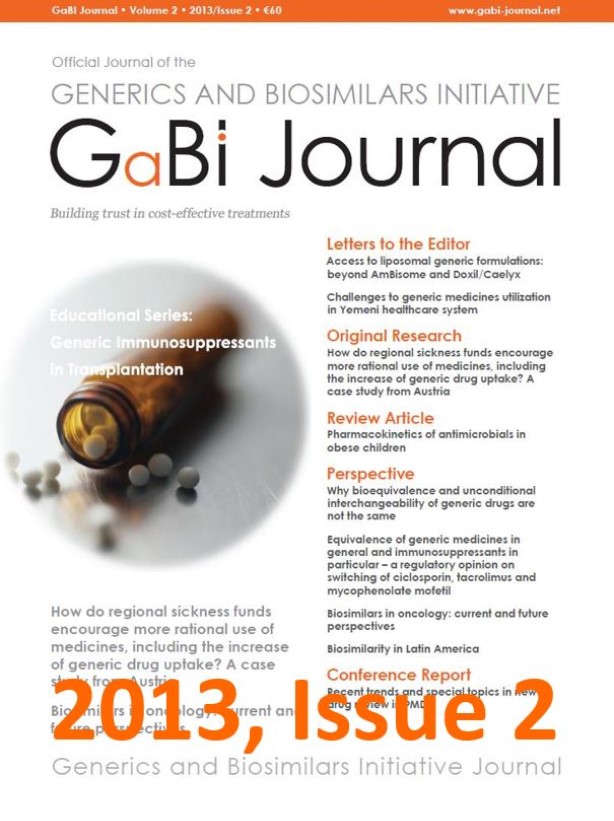
What to look forward to in GaBI Journal, 2013, Issue 2

The first of two Letters to the Editor is from Ms Gaspani and Ms Milani expressing their concerns about the lack of clear regulatory guidelines for approval of liposomal generic formulations. Liposomal products are only one and perhaps some of the best-characterized example of non-biological complex drugs (NBCDs). NBCDs while not having a biological source…

Author(s): Professor Philip D Walson, MD

DOI: 10.5639/gabij.2013.0202.028


5.047 views

For Patients

Published on 19 October 2012

IAPO launched the Patient-Centred Healthcare Indicators Review

Submitted: 9 January 2013; Revised: 11 January 2013; Accepted: 15 January 2013; Published online first: 22 January 2013 In October 2012, the International Alliance of Patients’ Organizations (IAPO) launched its final Patient-Centred Healthcare Indicators Review and accompanying consultation report [1]. The review forms the initial stage of a wider project being undertaken by IAPO to develop a set of process and outcome…

Author(s): Yasemin Dil

DOI: 10.5639/gabij.2013.0201.005


7.522 views

Pharma News

Published on 07 February 2013

‘Similar biologics’ approved and marketed in India

There have been established guidelines for approving generic versions of small molecule chemical drugs in India for some time already. However, no specific guidelines for ‘similar biologics’, as the Indian regulatory authorities call these products, have existed in India until recently. This has been the case despite the fact that the requirements for granting regulatory…

Author(s): GaBI Journal Editor

DOI: 10.5639/gabij.2013.0201.006


13.336 views

Abstracted Scientific Content

Published on 29 November 2012

Alleviating concerns around generic antiepileptic medications

Epilepsy features the unpredictable onset of seizures that can be devastating to a patient’s quality of life. Fortunately there are medications available to control the onset of seizures. But because these have to be taken over the long term, healthcare providers need to consider whether to take advantage of cheap generic alternatives to brand-name antiepileptic…

Author(s): GaBI Journal Editor

DOI: 10.5639/gabij.2013.0201.002


14.195 views

Guidelines

Published on 19 April 2013

EORTC continues to support the appropriate treatment of adult patients with G-CSF to prevent febrile neutropenia: guideline updates

Abstract:  The European Organisation for Research and Treatment of Cancer (EORTC) has updated its 2006 guideline on the use of granulocyte colony-stimulating factor (G-CSF) for the prevention of febrile neutropenia (FN), a sometimes fatal condition in which a loss of neutrophils in patients receiving chemotherapy leads to infections and fever. The guideline provides recommendations on…

Author(s): GaBI Journal Editor

febrile neutropenia, G-CSF, leukaemia, lymphoma, myelosuppression, risk

DOI: 10.5639/gabij.2013.0201.016


8.636 views

Guidelines

Published on 12 February 2013

New CHMP guideline on immunogenicity of monoclonal antibodies

Author byline as per print journal: Robin Thorpe, PhD, FRCPath; Meenu Wadhwa, PhD Abstract: The importance of monoclonal antibodies as a product class and the challenge of assessing unwanted immunogenicity for these products have prompted the drafting of a new CHMP (Committee for Medicinal Products for Human Use) guideline. The ‘Guideline on immunogenicity assessment of…

Author(s): Meenu Wadhwa, PhD, Robin Thorpe, PhD, FRCPath

biosimilar, comparability, quality, risk, safety

DOI: 10.5639/gabij.2013.0201.007


13.798 views